



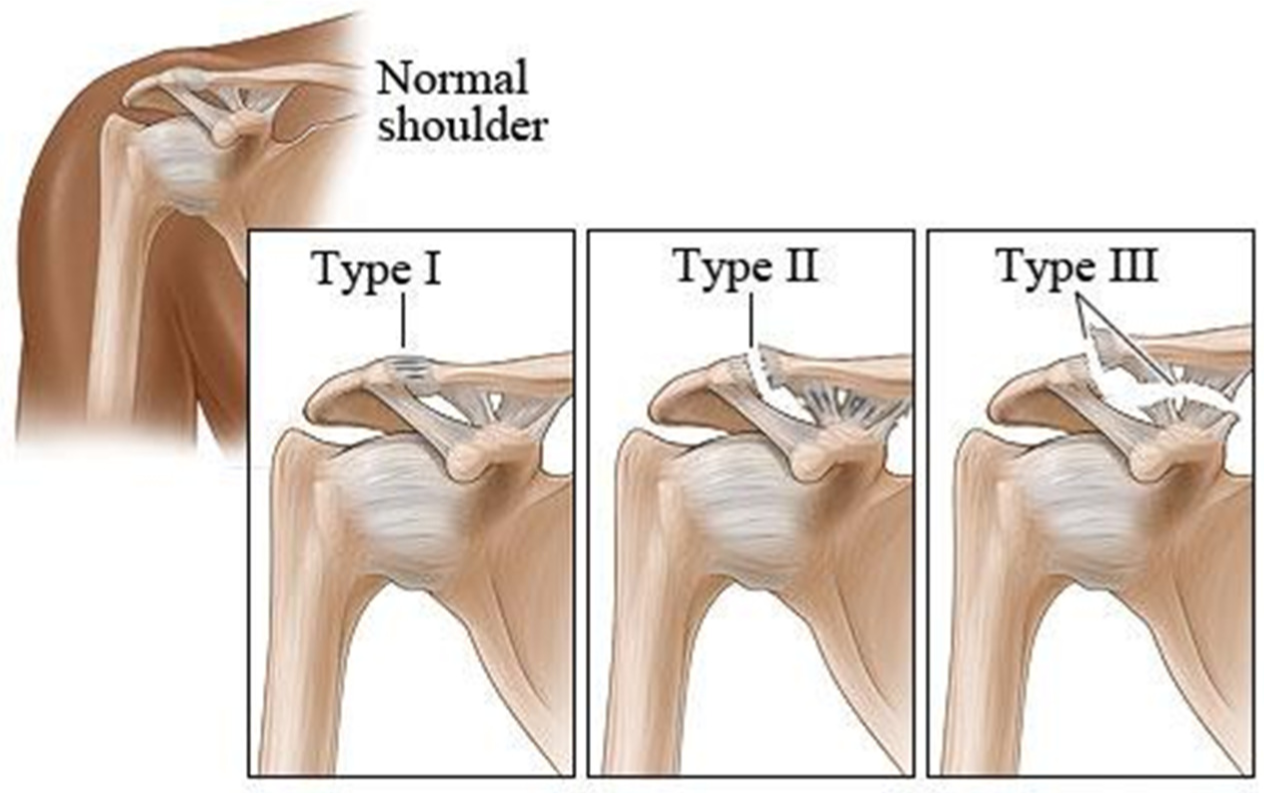
The acromioclavicular (AC) joint is commonly injured in hockey when players sustain a direct hit or fall onto the shoulder. Indeed, a torn AC ligament is referred to as a separated shoulder.
The acromioclavicular joint is the joint between the collarbone (clavicle) and the acromion, a part of the shoulder blade which forms the roof of the shoulder joint. Ligaments reinforce the fibrous capsule and can be torn with a direct blow (i.e. checked into the boards) or a fall.
There are six degrees of tears. The 1st degree tear involves a partial tear of the AC ligament with no instability or deformity. Patients have some pain with elevating the arm above shoulder height and reaching across to the other shoulder. Grade 2 tears involve two ligaments, with a complete tear of the AC ligament and a partial tear of another supporting ligament. There is a slight step deformity where the clavicle pops up and some associated instability, bruising, and swelling. Grade 3 tears involve complete tears of the two major supporting ligaments of the AC joint: the acromioclavicular and coracoclavicular ligaments. The step deformity is quite visible and with resulting joint instability. Grades 4, 5, and 6 involve more extensive damage and dislocation of the AC joint. Note that a grade 3 tear is not often seen in children under the age of 13 years; instead, children tend to sustain a fracture of the clavicle which is treated with a period of immobilization in a sling.
Signs and symptoms of a separated shoulder are usually point tenderness over the joint line, possible swelling, pain in all shoulder movements, particularly reaching forward and across the body which can also be restricted. Depending on the grade of ligament tear, the end of the clavicle can elevate and appear like a bump. A palpable step is evident with a significant tear. An X-ray will show the displacement and reveal if there is any widening of the joint space.
Treatment varies depending on the degree of ligament tearing. Grade 1 tears do well with early motion and strength training. Grade 2 & 3 tears usually require use of a sling initially to allow sufficient ligament and capsular healing. Physiotherapy is very beneficial in guiding the rehabilitation of AC joint separations. Most grade 1-3 AC joint injuries heal with conservative treatment . While the grade1and 2 injuries tend to be resolved in 6-8 weeks, the grade 3 injuries just require a bit more time to allow sufficient scar tissue formation and healing. Strength training is not introduced until 8 weeks and sometimes longer depending on the severity of the injury. Full return to sport is usually 3 months. The severe tears (grade 4, 5, and 6) usually require surgery with fixation followed by physiotherapy rehabilitation.
Written by Sue Reive PT
OPTSC Glebe